Science-Based Strategies for Mentoring, Mindsets and Motivation
Over two transformative days, you’ll gain practical tools to mentor and lead with confidence, so you and those you support can thrive at home, at work and at school. This year’s theme, Science-Based Strategies for Mentoring, Mindsets and Motivation, invites us to strengthen how we lead, support and inspire others to achieve higher levels of wellbeing.
When: August 27th–28th, 2026 Location: Ridley College, St. Catharines, ON
Attending the Flourish Conference was amazing. The speakers were incredible, the other attendees were engaged and engaging, and the whole conference was phenomenally organized and communicated. I would actually like the entire staff at my school to attend the conference next year! We are so excited and hope to be able to bring our new learning to our colleagues and students!
— 2025 Flourish Conference Attendee
Who Should Attend
Team and department leaders
K–12 and postsecondary educators
Coaches and mentors
parents and caregivers
Wellbeing practitioners
What to Expect
Join keynote and featured speaker sessions for actionable, practical strategies you can apply you all areas of your life.
Participate in engaging breakout sessions designed to boost your wellbeing and performance — and empower those you lead and care for.
Connect with peers during networking opportunities between sessions and after the conference. This was direct feedback from attendees last year, so we’re buildingin more time for connections.
Discover Niagara with evening transportation provided to Niagara-on-the-Lake.
Keynote Speaker
David Yeager
David Yeager is the author of 10 to 25: The Science of Motivating Young People, a USA Today bestseller. Based on cutting-edge research, it reveals how parents, mentors and leaders of young people aged 10–25 can harness their desire to be respected, resulting in breakthrough connection, enthusiasm and cross-generational collaboration. He explains how to adopt what he calls “the mentor mindset”: a leadership style that’s attuned to young people’s neurobiological need for status and respect. The practices he offers, like asking questions instead of giving orders, are proven to improve behaviour across a wide variety of areas, from purpose to mental health. Young people in this age group are poised to learn, grow and accomplish incredible things, he says — if we can just tap into the basic systems that drive their motivation and behaviour.
David is an experimental development psychologist in the department of psychology at the University of Texas at Austin. Over the past 10 years, he has been one of the top 0.1% most-cited psychologists in the world. In his academic research, he examines the causes of and solutions to adolescent health problems, such as bullying, depression, academic achievement, cheating, trust, or healthy eating. He often focuses on adolescent transitions—the transition to middle school, the transition to high school, or the transition to college—as a place where there is great opportunity (and risk) for young people’s trajectories. Formerly, David was a middle school English teacher and a K-8 PE coach for a school in Tulsa, Oklahoma, where he also ran the after-school book club and coached basketball.
David was the subject of a major New York Times Magazine article (“Who Gets to Graduate?”) by education speaker Paul Tough, in which he was named “one of the world’s leading experts on the psychology of education.” He has co-authored work on grit and grit-testing with Angela Duckworth, and on growth mindset with Carol Dweck. He chaired and co-hosted a national summit on mindset interventions at the White House Office for Science and Technology Policy, which led to the launch and co-chairing of the “Mindset Scholars Network,” an interdisciplinary research network housed at the Center for Advanced Study in the Behavioural Sciences (CASBS), where he was a fellow. His work has appeared in The New York Times, The Atlantic, Scientific American, The Wall Street Journal, The Guardian, and more.
David holds a PhD and MA from Stanford University, and a BA and MEd from the University of Notre Dame. He is a William T. Grant Foundation scholar, a Faculty Research Associate at the UT Population Research Center, and was formerly a Fellow at the Carnegie Foundation for the Advancement of Teaching. His research has earned awards from the Spencer Foundation, the Society for the Psychological Study of Social Issues, the Society for Research on Child Development, the American Educational Research Association, the APA Science Directorate, and the International Society for Research on Aggression. He is a member of the Human Capital and Economic Opportunity Global Working Group and the New Paths to Purpose network at the University of Chicago.
Featured Speaker
Toby Shannan
Shannan is on the Board of Directors of Shopify, the multinational e-commerce company and is the former Chief Operating Officer of Shopify and spent 12 years leading global operations as well as its customer support and service strategy. Prior to joining Shopify, Shannan also held the role of Vice President, Sales and Marketing, at DNA Genotek, where he was instrumental in commercializing Oragene, the kit used in collection of saliva samples for in vitro diagnostic testing of human DNA. Shannan is a board member and trustee at the Santa Fe Institute. The Santa Fe Institute is an independent, nonprofit theoretical research institute dedicated to the multidisciplinary study of the fundamental principles of complex adaptive systems, including physical, computational, biological and social systems. Lastly Shannan is starting a heritage trades school in Perth Ontario.
We are pleased to offer a special room rate for conference attendees at the following locations close to the Outlet Collection at Niagara and White Oaks Resort and Spa for extra value added to your stay. Shuttle service to and from the conference will be available for those staying at either of these hotels.
The deadline to reserve your accommodation at the special group rate is July 20th. Don't delay!
At Ridley College, we believe the primary aim of education is the cultivation of human flourishing. As such, this has been at the heart of our approach to learning for over a decade.
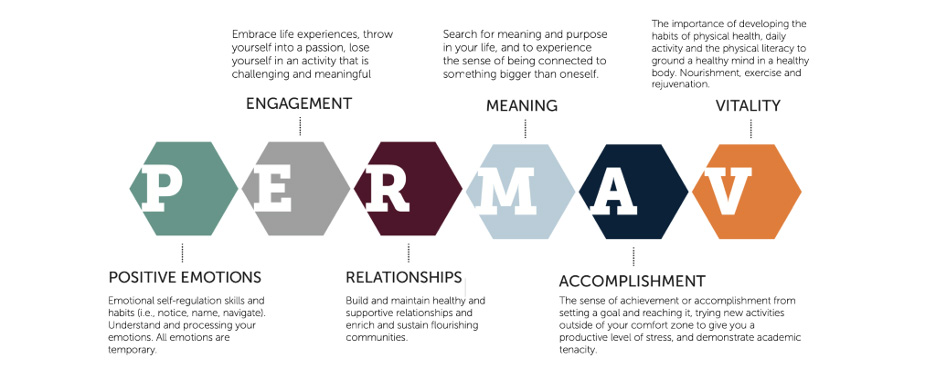
We define 'flourishing' as PERMA-V, the human development theory developed by Dr. Martin Seligman. Each of the letters represents pillars of wellbeing that are foundational to everything we do at Ridley.
Integrating positive education practices into a school culture offers a wide range of benefits for both students and educators. Here are some of the key advantages:
✓
Improved Wellbeing: Positive education fosters emotional resilience, self-awareness, and stress management skills, leading to improved overall mental and emotional wellbeing among students and educators.
✓
Enhanced Academic Performance: When students are emotionally and mentally healthy, they are better able to focus on their studies and engage in the learning process, ultimately leading to improved academic performance.
✓
Positive School Climate: Implementing positive education practices creates a more inclusive, respectful, and harmonious school environment. It reduces instances of bullying, conflict, and disciplinary issues.
✓
Character Development: Students develop important character strengths such as empathy, gratitude, perseverance, and kindness, which contribute to their personal growth and prepare them for success in various aspects of life.
✓
Increased Motivation: Positive education encourages a growth mindset, fostering a love for learning and a sense of purpose, which significantly increases students' motivation to excel academically.
✓
Teacher Satisfaction: Educators who implement positive education practices report higher job satisfaction, lower stress levels, and reduced burnout. They feel more supported and fulfilled in their roles.
✓
Long-Term Impact: The skills and values instilled through positive education can have a lasting impact on individuals, helping them make meaningful contributions to society and promoting positive change in the world.
Flourish Conference 2025
The Flourish Conference, hosted by Ridley College in August 2025, brought educators and business leaders from across North America to Ridley College to advance their understanding and application of the science of Positive Education.
The event featured keynote speakers Emiliya Zhivotovskaya, Dr. Greg Wells, Dr. Sabre Cherkowski and Irshad Manji.